31‏/01‏/2021

China Is Building Green Cities, But Struggling to Find Residents


Eco city near Chengdu is a far cry from China’s polluted industrial centers 

Just outside the southwestern city of Chengdu, China is building an urban paradise bigger than Houston. Visitors are greeted by a sea of manicured grass encircling a man-made lake, dotted with water lilies, that is almost the size of New York’s Central Park. 

This is Tianfu Park City, one of hundreds of “eco city” developments taking over farms and rural land in China as the government tries to accommodate the 100 million people it had planned to move from villages into urban areas by 2020.  After decades of unbridled urbanization that allowed concrete high-rise suburbs to sprawl around its big cities, eating up farmland and creating pollution, China is trying to find a more sustainable way to grow and provide citizens with a better lifestyle.

“The air here is really good and wherever you go it’s green,” said a 56-year-old resident surnamed Fan, who moved to the area in 2013 when it was still a neglected suburb of Chengdu. “I don’t regret my decision at all, my apartment’s value has doubled.”

The Tianfu project was approved a year after Fan arrived, bringing an influx of government support that helped boost property prices. In the first half of 2019 alone, the city signed contracts for more than 300 billion yuan ($44 billion) of investment. When major construction is completed this year, nearly 60% of the area will be dedicated to six artificial lakes, 30 parks and other green spaces. The population will be limited to 6.3 million by 2030 –  a quarter of the size of China’s biggest cities, such as Shanghai.

“New cities are like experiments where the governments can easily test innovative ideas,” said Zheng Siqi, faculty director of the Massachusetts Institute of Technology’s Sustainable Urbanization Lab. “The new city does not need to deal with existing residents,” unlike when the government redevelops existing ones, Zheng said.

China Is Building a Green Paradise, But Will People Live There?
While Tianfu Park City includes hundreds of acres of parks and trees, some developments have struggled to attract tenants.
Photographer: Qilai Shen/Bloomberg

China’s green approach is designed to tackle two pressing environmental issues. Large-scale construction of urban infrastructure and residential housing has become one of the country’s biggest sources of greenhouse gases. Realizing the nation’s urbanization goal could produce more than one gigaton of additional carbon dioxide, according to a study by researchers at the University of Maryland. At the same time, both rural and urban environments have deteriorated. Most of China’s major cities suffer from filthy air and poor quality water. About 90% of China’s grasslands and 40% of its major wetlands are experiencing degradation, according to the Ministry of Ecology and Environment.

In 2012, President Xi Jinping began stressing his theory of an “eco-civilization,” where development takes environmental costs into consideration. The aspiration hasn’t always translated into concrete policies. Government guidelines on building new cities contain buzzwords like “low-carbon” and “environmental protection,” but few specific requirements in terms of energy efficiency and building materials.

‘Park City’

Tianfu has flourished because of Xi’s personal endorsement. In 2018, he visited Chengdu and remarked that its development should “highlight the characteristics of a park city.” Local cadres quickly added “park city” to its official name and put up street banners proclaiming its “park city” status. A Park City Research Institute was established to help the project become “a globally famous and successful model” for urbanization.

Explore dynamic updates of the earth’s key data points
Open the Data Dash
4
3
2
1
0
5
4
3
2
1
0
9
8
7
6
2
1
0
9
8
6
5
4
3
2
3
2
1
0
9
9
8
7
6
5
4
3
2
1
0
6
5
4
3
2
9
8
7
6
5
6
5
4
3
2
5
4
3
2
1
8
7
6
5
4

Wu Changhua, senior researcher at Beijing-based think tank Center for China and Globalization, said China’s policies show the top leadership is determined to restore the environment, but that’s not always what motivates local bureaucrats. “A deeper driver could be lush subsidies and stimulus for economic growth,” she said.

relates to China Is Building Green Cities, But Struggling to Find Residents
People walk along an almost empty lakeside jogging track in one of Tianfu’s new parks.
Photographer: Sharon Chen/Bloomberg

Of the hundreds of projects classified as “eco-city” developments, many don’t employ sustainable strategies such as energy efficient buildings, smart traffic layouts and renewable energy, said Deng Wu, an associate professor at the Department of Architecture and Built Environment at the University of Nottingham Ningbo China.

Developers often advertise their buildings as “eco-friendly” because they maintain stable temperature, humidity and oxygen levels indoors, but achieving that actually requires consuming large amounts of power, he said. “They equate ‘eco-friendly’ to being comfortable, but these projects have nothing to do with being eco-friendly, and can even have the opposite effect.”

To many residents, the beautiful landscaping and modern buildings in Tianfu embody the “eco city” ethos, and are a huge improvement from the poorly built cities of the past. In their view, clean air, water and streets are more important barometers of “eco-civilization” than buildings that conserve energy.

Luring Residents

But cities need businesses and jobs to grow, not just pretty parks. In Tianfu’s central business district, some local companies lured by government subsidies and tax breaks have moved into the new skyscrapers, though the area is far from bustling. Global chains like Starbucks Corp. and Pizza Hut Inc. have opened outlets on the waterfront, where property agents hawk apartments to pedestrians, talking up the government’s investment in the area.

It’s too early to say if Tianfu will attract enough residents, said MIT’s Zheng. “There could be far more supply than demand if people don’t feel the need to move to a newly built city, especially where the existing city is not fully used yet,” she said, referring to Chengdu, which in recent years has become a popular destination for young people escaping high rents in places like Beijing and Shanghai.

China Is Building a Green Paradise, But Will People Live There?
Tianfu’s artificial lakes and green spaces cover more than half the city.
Photographer: Qilai Shen/Bloomberg

It’s a story that’s played out in China before. Tianjin’s Binhai New City, along the east coast, was envisioned as a new financial powerhouse when former Premier Wen Jiabao launched the project more than 10 years ago. In 2019, only 100,000 people lived and worked in the Sino-Singapore Eco City, Binhai’s flagship project, far short of the government’s goal of having 350,000 permanent residents by 2020.

Fifteen minutes’ drive down a newly built highway leading out of Tianfu, residents of Hongxiang village played mahjong on a Sunday afternoon in July, chatting about the metropolis rising nearby. Surrounded by paddy fields and bamboo forests, they wondered when their village would be demolished to make room for Tianfu and whether they would be compensated for relinquishing homes that have been passed down for generations. A 67-year-old farmer, who gave her last name as Zhou, worried that she wouldn’t be eligible for a pension or health care in the city, even though she would have lost her only means of support.

Wang Xuelian, a 33-year-old mother of two, was puzzled by the whole notion of an eco-city. “Every day when I open my window I get to see nature. I don’t know why they want to demolish it to build some fake greenness,” she said.


Singapore’s New City of the Future Is Its Greenest Project Yet


 Updated on 
  •  
    Planners bring together dozens of carbon-cutting technologies
  •  
    Island nation redesigns public housing to meet emissions goal
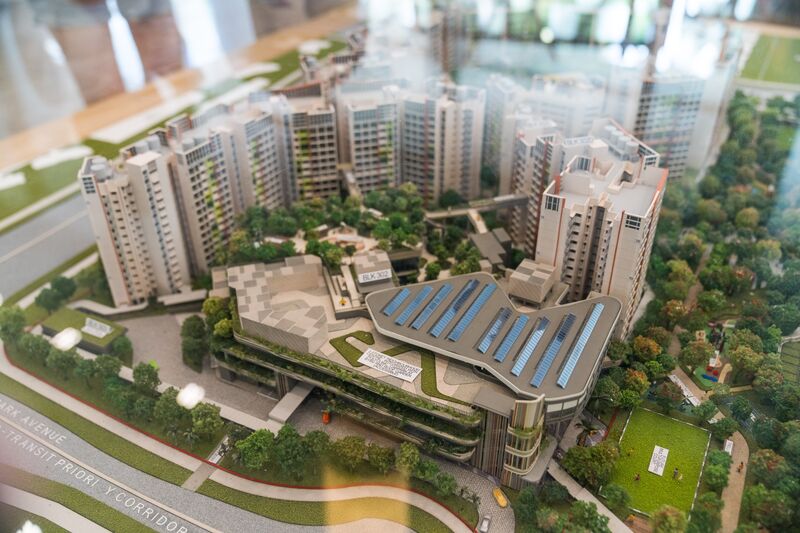
A model of Tengah shows a blend of solar energy, vertical gardens and rooftop cooling plants.
A model of Tengah shows a blend of solar energy, vertical gardens and rooftop cooling plants. Photographer: Lauryn Ishak/Bloomberg

Follow Bloomberg on LINE messenger for all the business news and analysis you need.

Giant solar-powered air-conditioners, vacuum garbage collection, subterranean roads for electric vehicles, urban farms and green architecture. Put them all together and you have Tengah, Singapore’s most ambitious project yet to build the city of the future.

Tengah, which means ‘center’ in the local Malay language, is part of Singapore’s effort to reduce a carbon footprint that’s bigger than some countries that are 50 times its size, and to promote sustainability in energy, water and waste. The Southeast Asian nation, which is smaller than New York City, has set a target of capping its emissions by around 2030 and then halving them by 2050.

Model Green City Rises as Tropical Singapore Tries to Stay Cool

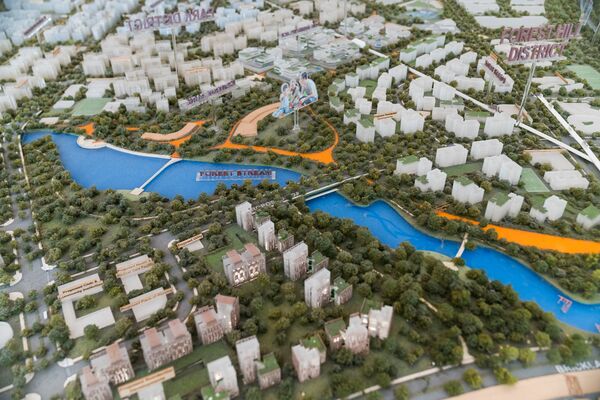
A model of the new district, where car parks and access roads would be underground, giving more space for gardens and cycleways.

Photographer: Lauryn Ishak/Bloomberg

Key to reaching that goal will be to tackle the city’s debilitating tropical heat and humidity, while cutting the nation’s ever-rising energy bill for air-conditioning.

Once described by founding prime minister Lee Kuan Yew as the greatest invention of the 20th century, air-con is now widespread in homes and offices. The nation has more cooling units per capita than anywhere else in Southeast Asia. With tropical temperatures averaging around 27 Celsius (81 Fahrenheit) year-round and rising, the amount of power needed to cool Singapore is projected to grow 73% between 2010 and 2030, according to local research.

To slow the increase, the new town will use a district cooling network based on a commercial system in Singapore’s Marina Bay Financial District, where refrigeration plants and pipes were laid underground before the offices were built.

Singapore’s Giant Air-Con System Is Helping Curb Energy Drain

In Tengah, the cooling units will be solar powered and installed on rooftops of public-housing blocks, with chilled water piped through the buildings. The system’s operator, SP Group, says the network can cut energy use by 30% -- an emissions saving equivalent to 4,500 gasoline-powered cars. Residents have the option of connecting to the centralized cooling, or buying and running their own traditional air-con units.

“The biggest challenge that we face is to get residents to sign up,” said S Harsha, Singapore managing director of sustainable energy solutions at SP Group. The key is to show residents how the energy-efficient system can save them money, he said.

Since the government’s Housing and Development Board began offering 8,000 flats in the new estate in 2018, close to 1,000 buyers have signed up for the centralized cooling, which Harsha said would be cheaper to install than a normal system. Homes in Singapore’s new public housing projects are sold at a subsidized price to citizens -- mostly young married couples -- based on a ballot before construction begins. The first batch of Tengah’s planned 42,000 flats will be ready by late 2022 or in 2023.

Young couple Shaun Wong and Beverly Tan said it was the project’s green credentials that made them decide to apply for one of the homes.

“We’re merely perpetuating a practice that we’ve adopted,” said 23-year-old Tan, who runs an e-commerce business and said she favors eco-friendly clothes and household products and prefers to use a fan rather than air-con. “Practice what you preach.”

Once the site of brickworks and pepper plantations, the new town will have five districts with community farming, garden and forest themes. A 100 meter-wide, 5 kilometer-long corridor of trees will run through the district, connecting it with the island’s central nature reserve.

Singapore Prepares for a Far Hotter World Than Experts Predicted

Each of the 42,000 government-built apartments will have a ‘smart’ dashboard that allows homeowners to monitor energy consumption.

Model Green City Rises as Tropical Singapore Tries to Stay Cool

Residents will be able to control appliances and home systems remotely via a smartphone app.

Photographer: Lauryn Ishak/Bloomberg

Rail networks, access roads and car parks will mostly be below ground, freeing space for gardens, urban farming and for walking and cycling. Singapore is turning its attention to electric vehicles following Hyundai Motor Group’s investment in a new innovation center that may produce up to 30,000 vehicles a year by 2025. Charging stations will be installed in the new town’s car parks.

Smart Design

The HDB used 3-D environmental modeling software to create the blueprint for Tengah, simulating the effects of changes in wind, temperature and sunlight on buildings and their surroundings. The aim was to find the best way to design and orientate buildings, vegetation, water and open spaces to promote shade and natural ventilation and mitigate the urban heat-island effect.

relates to Singapore’s New City of the Future Is Its Greenest Project Yet

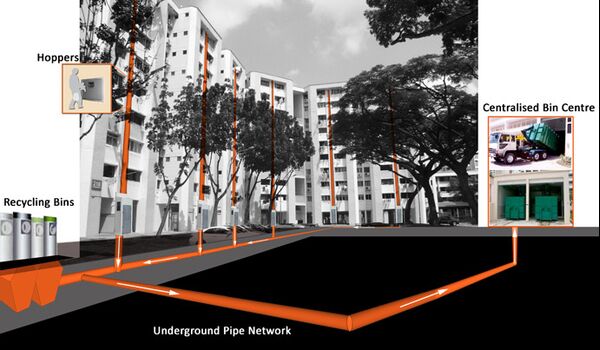
Tengah’s automated waste collection system would use vacuum-driven underground pipes to collect household refuse.

Source: Housing & Development Board

An automatic pneumatic waste conveyance system will collect trash through underground pipes. “It helps create a cleaner and more hygienic living environment by reducing odor and spillages associated with manual collection, and minimizing pest infestation,” the HDB said on its website.

SP Group is developing a waste management system that will turn the garbage into energy using a gasification plant -- a more efficient way of producing fuel than an incinerator.

The overall effect of the project is to move Singapore forward in its search for a truly green city, said Lahiru Wijedasa, co-principal investigator and senior research fellow at the National University of Singapore’s Environmental Research Institute.

“This is definitely a step in the right direction,” he said, especially the efforts to aid cooling. “Developments like this, in addition to efficient design of amenities, will have a far greater effect on reducing long-term carbon footprint than the actual greenery. Future developments will continue to push the boundary, and eventually our journey will lead to the most environmentally sustainable city possible at that particular time.”

المتحدث العسكرى المصرى


تغطية اغلامية رائعة للنادى الأهلى فى بطولة العالم


صحيفة الشرق الأوسط: إجهاض مخطط لإسقاط تكليف الحريري من تشكيل الحكومة


 قال مصدر مقرّب من رؤساء الحكومة السابقين في لبنان ، إن مخططاً كان يسعى لإسقاط تكليف الرئيس سعد الحريري تشكيل الحكومة ، تم إجهاضه، وذلك عبر أحداث طرابلس في شمال لبنان -حسب صحيفة الشرق الأوسط. 

وحسبما كشف المصدر، كان المخطط يقضي بإقحام عاصمة الشمال في حالة من الفوضى يترتب عليها اندلاع صدامات دامية بين المنتفضين على واقعهم المعيشي الذي لم يعد يطاق، وبين القوى الأمنية لإسقاط تكليف الحريري تشكيل الحكومة الجديدة في الشارع ال طرابلس ي، وبالتالي الضغط عليه للاعتذار عن عدم تأليفها.

وقال لـ«الشرق الأوسط» إن المخطط الذي استهدف عاصمة الشمال وُئد في مهده، وإن الحريري سيبقى صامداً في موقفه ولن يحيد عن رؤيته لقيام حكومة طبقاً للمواصفات التي حددها الرئيس الفرنسي إيمانويل ماكرون في مبادرته لإنقاذ لبنان .

وجد المصدر تأكيد أن رؤساء الحكومة السابقين لا يزالون على موقفهم الداعم للحريري الذي لن يقدّم اعتذاره عن عدم تأليف الحكومة وسيبقى صامداً ولن يخضع لحملات الابتزاز والتهويل.

قصة "نيباه" الذي بدأوا يحذّرون من عودته كوباء عالمي


اسم Sungai Nipah هو لبلدة في ماليزيا، وأيضا لفيروس موصوف في سجلات "منظمة الصحة العالمية" بمعد وقاتل، إلى درجة أن سينمائيين نسجوا من خطره قصة حولوها في 2011 إلى فيلم سمّوه Contagion أو "عدوى" الهوليوودي المرعب، واستوحوا القسم المتعلق فيه بالخفافيش والخنازير، من ظهوره في 1997 على عامل من أبناء تلك البلدة في مزرعة لتربية الخنازير، ففتك بخلاياه العصبية والتنفسية وجعله القتيل الأول، لذلك سمّوه "فيروس نيباه" المحذرة من عودته تقارير صدرت حديثا، وتتوقع أن ينافس "كورونا" المستجد بالفتك والشراسة، إذا ما انتشر.

الفيروس الذي قتل 105 من 265 أصابهم بعد انتشاره الأولي في 1998 بماليزيا، يتبرعم في خلايا الإنسان والحيوان معا، خصوصا في الخنازير، كما بما يسمونه "خفافيش الفاكهة" المعروفة بكبر أحجامها، وبانتشارها في اليمن والصومال والسودان وأفريقيا الوسطى وغيرها، وفقا لما تستخرج "العربية.نت" من سيرته الوارد منها مزيد من المعلومات في الفيديو المعروض أدناه، وهو وثائقي أعدوه في 1999 بعد عزله ذلك العام ودراسته والتعرف إلى خطره المحذرة منه هيئات صحية عالمية.

اسم Sungai Nipah هو لبلدة في ماليزيا، وأيضا لفيروس موصوف في سجلات "منظمة الصحة العالمية" بمعد وقاتل، إلى درجة أن سينمائيين نسجوا من خطره قصة حولوها في 2011 إلى فيلم سمّوه Contagion أو "عدوى" الهوليوودي المرعب، واستوحوا القسم المتعلق فيه بالخفافيش والخنازير، من ظهوره في 1997 على عامل من أبناء تلك البلدة في مزرعة لتربية الخنازير، ففتك بخلاياه العصبية والتنفسية وجعله القتيل الأول، لذلك سمّوه "فيروس نيباه" المحذرة من عودته تقارير صدرت حديثا، وتتوقع أن ينافس "كورونا" المستجد بالفتك والشراسة، إذا ما انتشر.

الفيروس الذي قتل 105 من 265 أصابهم بعد انتشاره الأولي في 1998 بماليزيا، يتبرعم في خلايا الإنسان والحيوان معا، خصوصا في الخنازير، كما بما يسمونه "خفافيش الفاكهة" المعروفة بكبر أحجامها، وبانتشارها في اليمن والصومال والسودان وأفريقيا الوسطى وغيرها، وفقا لما تستخرج "العربية.نت" من سيرته الوارد منها مزيد من المعلومات في الفيديو المعروض أدناه، وهو وثائقي أعدوه في 1999 بعد عزله ذلك العام ودراسته والتعرف إلى خطره المحذرة منه هيئات صحية عالمية.

أول مكافحات لجأوا إليها ضد "نيباه" الذي تسبب بأكثر من 700 حالة مرضية بشرية منذ مايو 2018 حتى أواخر العام الماضي، فقتل بين 50 إلى 75% من المصابين، هو الإسراع إلى مزارع تربية الخنازير، حيث تم قتل الملايين منها. لكن ما نسمعه في الفيديو من مختصين بالفيروس هو خطر انتشاره بين البشر، لأن نسبة قتله للمصابين عالية جدا، لذلك اعتبروه أشد شراسة وفتكا من المستجد الكوروني نفسه.

التهاب بالدماغ ولو بعد الشفاء

أما أعراضه بعد انتقاله من إنسان لآخر، أو من حيوان لإنسان عبر الاتصال المباشر، فمنها سعال وصداع وضيق بالتنفس، قد يؤدي بصاحبه إذا احتدم بعد يوم أو يومين إلى التعرض لغيبوبة، حتى والتهاب بالدماغ "ولو بعد الشفاء" فيما لو حالفه الحظ وخرج متعافيا، علما أنه لا يوجد للآن أي لقاح يتصدى له ويمنع عدواه، سوى الوقاية، أي كما الحالة مع المستجد حتى الآن، إلى أن تثبت اللقاحات العكس.

وأهم خطوات الوقاية هي عدم الاتصال المباشر بالخنازير المريضة وأماكن عيشها، ولا بالخفافيش ومجالات تحركها، وبالذات عدم شرب عصارة نخيل التمور الخام، فقد تم تصوير خفافيش وهي تشرب من "النسغ" أو إنزيم التمر أثناء جمعه في الجرار من أعالي الأشجار، بحسب ما يتضح من الصورة المنشورة، كما مما نشرته "العربية.نت" في خبر آخر من موقعها أمس، نقلا عن تقرير ورد في صحيفة "الغارديان" البريطانية يوم الجمعة، وحذر من تفشي الفيروس في الصين بمعدل وفيات يصل إلى 75% ومن إمكانية تسببه بجائحة عالمية مقبلة أخطر من كورونا.

من المعلومات عن "نيباه" أيضا، أن أعراضه تبدأ بالظهور بعد 3 إلى 14 يوما، وأن خطره يحيط أكثر بالعاملين في المستشفيات والقائمين على رعاية المصابين، كما بالمتعاملين مع الخنازير، وبالمصابين به من البشر، وخطر تسببه بالموت يشمل كافة الأعمار والمستويات.

أما الدول التي ابتليت به أكثر من سواها، فهي ماليزيا وسنغافورة وبنغلادش والهند، حيث شهدت الأخيرة في 1999 وفاة أول ممرضة كانت تعالج مصابين، ففارقت الحياة بعمر 31 سنة تقريبا، ثم تلاها وفاة 18 آخرين في مقاطعات مختلفة، إضافة إلى عزل المشتبه بحالاتهم في حجر صحي، لم تثبت محاولات العلاج خلاله جدواها إلا لدى من كانت إصاباتهم أقل من إصابات المتوفين.


الأحدث

​انتحار الأيديولوجيا: كيف تحولت أحزاب مصر التاريخية إلى "ديكور" في قطار الائتلاف المستأنس؟

​..... ​بينما يئن الشارع المصري تحت وطأة ضغوط اقتصادية طاحنة غير مسبوقة، تُعيد المشاهد البرلمانية والسياسية الحالية طرح التساؤل ...